Updated: May 2026
Helicopter Transfer vs. Private Car in Bali: Which is Better?
When comparing a helicopter transfer vs a private car in Bali, the choice hinges on valuing time and experience over budget. A helicopter dramatically reduces travel time, turning a multi-hour drive into a short, scenic flight. While a private car offers ground-level accessibility at a lower cost, a helicopter provides an exclusive, elevated perspective of the island’s geography.
- Time Efficiency: A helicopter cuts a 2-hour drive from the airport to Uluwatu down to approximately 12 minutes.
- Experiential Value: Flying offers unique aerial views of volcanoes, rice paddies, and coastlines, transforming a transfer into a tour.
- Practicality: Cars provide door-to-door service, whereas helicopters require designated helipads and have stricter luggage limitations.
The air is thick with the scent of frangipani and clove. Below, the Indian Ocean crashes against the limestone cliffs of the Bukit Peninsula, a relentless, percussive rhythm. You’ve just arrived, but instead of the familiar crawl of traffic leaving Ngurah Rai International Airport, you’re experiencing Bali from an entirely different dimension. This is the essential question for the modern luxury traveler on the Island of the Gods: do you experience in the chaotic beauty of its roads or rise above it all? The debate of helicopter transfer vs private car in Bali is not merely about getting from A to B; it’s a decision that defines the very first chapter of your island story.
The Tyranny of Time: Deconstructing Bali’s Traffic Problem
To understand the appeal of a helicopter in Bali, one must first understand its traffic. It’s a complex, living entity, a challenge that even the most seasoned travelers find formidable. According to data from the island’s official tourism portal, indonesia.travel, visitor numbers have consistently surged, with over 5.2 million foreign arrivals in 2023 alone. This influx, combined with a narrow road infrastructure not designed for such volume, creates significant congestion. A seemingly short 40-kilometer journey from the airport in Denpasar to the cultural heart of Ubud can frequently take two hours, and during peak season or a ceremonial procession, it can stretch to three. As Jean-Marc Dubois, a luxury travel consultant I spoke with in Geneva, puts it, “The first and last hours of a client’s vacation are the most critical. Wasting three of them in traffic is a cardinal sin of travel planning.” A private car, while comfortable, is still subject to these ground-level realities. The route to Canggu, a mere 20 kilometers, can become a 90-minute ordeal of stop-and-go traffic. In sharp contrast, a helicopter transfer bypasses this entirely. That same journey from the airport to a helipad near Ubud is completed in roughly 18 minutes. It’s a staggering reclamation of time, transforming a stressful commute into a seamless transition. For those whose time is the ultimate luxury, the choice to explore the options for a bali heli charter becomes less of an indulgence and more of a logistical necessity.
The View from Above: An Unparalleled Perspective
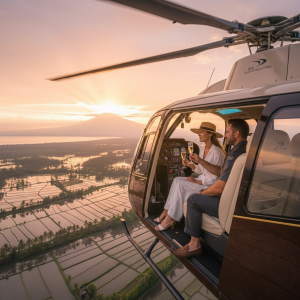
A private car journey through Bali offers a fascinating, ground-level tableau of island life: roadside warungs selling satay, vibrant temple ceremonies spilling onto the streets, and the intricate details of village architecture. It is an experience of immersion. A helicopter transfer, however, offers an experience of transcendence. It reframes the island’s geography, revealing the epic scale and interconnectedness of its landscapes in a way that is impossible from the ground. As you ascend, the patchwork of roads and villages gives way to a grander canvas. You see the dramatic volcanic spine of the island, dominated by the 3,031-meter peak of Mount Agung, an active stratovolcano detailed by Wikipedia, and its sibling, Mount Batur. The view reveals the island’s true character. To the south, the sheer cliffs of Uluwatu are not just a backdrop but a formidable coastal fortress. Flying north, you can trace the subak irrigation systems that feed the magnificent Jatiluwih Rice Terraces, a UNESCO World Heritage site, which appear as emerald-green, sculptural contours carved into the mountainside. This is not just a transfer; it is an orientation. You are not simply being transported; you are being introduced to the island in the most dramatic way possible. The transfer becomes an integral, memorable part of the vacation itself, a private aerial tour that sets the tone for the entire stay.
The Economics of Exclusivity: A Cost-Benefit Analysis
Let’s address the most tangible difference: the cost. A reliable private car with a driver for a transfer might cost between $50 and $100 USD. It is a practical and relatively affordable solution. A private helicopter transfer is a different category of service, with prices for a one-way trip typically starting from $1,500 and increasing based on the aircraft size and distance. On the surface, the comparison seems stark. However, for the discerning traveler, the calculation is not one of simple expense but of value. Consider a group of four staying at a villa that costs upwards of $2,000 per night. Reclaiming three hours of their vacation time, which would have otherwise been spent in traffic, represents a significant return on investment. That’s three more hours to spend by the pool, exploring the local culture, or simply decompressing. “We encourage clients to think of the cost per hour of their actual vacation time,” Dubois explained. “When you factor in the value of that time, the premium for a helicopter becomes much more logical.” Furthermore, the helicopter transfer is an exclusive experience in itself. It’s a private, secure, and profoundly memorable event. When weighing the helicopter transfer vs private car in Bali, the financial aspect must be viewed through the lens of what is being purchased: not just transportation, but time, privacy, and an extraordinary memory.
Logistics and Accessibility: Ground Realities vs. Sky-High Freedom
The primary advantage of a private car is its ultimate flexibility. It offers true door-to-door service, capable of navigating the narrowest of laneways to deliver you to the precise entrance of your hotel, villa, or restaurant. There are virtually no luggage restrictions beyond what can fit in the vehicle. This convenience is undeniable. A helicopter operates on a different set of logistical principles. Its freedom in the air is predicated on specific infrastructure on the ground. Flights operate between licensed helipads. Fortunately, Bali’s luxury tourism ecosystem is well-equipped for this. Premier resorts like the Four Seasons Sayan, Mandapa a Ritz-Carlton Reserve, and The Mulia have their own on-site helipads, allowing for a truly seamless arrival. For destinations without a dedicated helipad, our team coordinates landings at the nearest approved location, with a pre-arranged private car ready to complete the final few minutes of the journey. Luggage is another key consideration. A typical charter on an aircraft like the Robinson R66 allows for approximately 15-20kg of luggage per passenger, preferably in soft-sided bags for easier storage. This requires more thoughtful packing than a car transfer would. It’s a trade-off: the boundless freedom of the skies requires a more structured approach on the ground. For a traveler who values precision and efficiency, these logistics are simply part of a well-executed plan.
Safety, Comfort, and Privacy: The Ultimate Luxury
When it comes to the core tenets of luxury travel—safety, comfort, and privacy—the helicopter presents a compelling case. While many private car services in Bali are professional, the industry has variable standards. A helicopter charter, by contrast, operates under the stringent regulations of the Indonesian Directorate General of Civil Aviation (DGCA). Pilots are highly experienced, often with thousands of flight hours, and the aircraft in our fleet of meticulously maintained aircraft undergo rigorous, scheduled maintenance checks that are internationally standardized. In terms of comfort, a premium vehicle is certainly pleasant. However, the experience of gliding above the island in a climate-controlled cabin, wearing noise-canceling Bose headsets to communicate with the pilot, is on another level. You are insulated from the noise, heat, and unpredictable nature of the road. But perhaps the most significant differentiator is privacy. A car journey is a public act. A helicopter transfer is an entirely private affair. From a private airport lounge to your exclusive cabin in the sky, you are in a controlled, secure environment. For high-profile individuals or those simply seeking absolute discretion, this is non-negotiable. The team at Bali Heli Charter understands that this bubble of privacy is paramount, ensuring every aspect of the journey is handled with the utmost confidentiality and professionalism. This trifecta of audited safety, superior comfort, and absolute privacy elevates the transfer from a simple service to a core luxury experience.
Quick FAQ: Helicopter Transfer vs. Private Car in Bali
Q: How much time do I realistically save with a helicopter transfer?
A: The time savings are substantial and depend on the route. For example, a trip from Ngurah Rai Airport (DPS) to the remote area of Sidemen, which can take 2.5 hours by car, is reduced to about 25 minutes by helicopter. A cross-island trip from the south to the north can save you over 4 hours of driving.
Q: What are the primary luggage restrictions for a helicopter?
A: Most charters have a per-person weight limit of around 15-20 kg (33-44 lbs). It is strongly recommended to use soft-sided duffel bags or suitcases, as they are much easier to fit into the aircraft’s cargo compartment compared to rigid, hard-shell cases.
Q: Is flying in Bali affected by weather?
A: Yes, safety is the top priority. Flights operate under Visual Flight Rules (VFR), meaning pilots need clear visibility. While Bali’s weather is generally favorable for flying, flights can be delayed or rescheduled due to heavy rain, low clouds, or high winds, particularly during the rainy season (typically October to April).
Q: Can a helicopter land directly at my private villa?
A: This depends entirely on the villa. Landing requires a safe, pre-approved, and often licensed landing zone. Many large estates have the space, but a site survey is required to ensure safety standards for approach, landing, and takeoff are met. We can facilitate this assessment for you.
Ultimately, the decision between a private car and a helicopter in Bali is a reflection of your travel philosophy. The car offers a practical, ground-level immersion into the island’s daily rhythm. It is a reliable and conventional choice. The helicopter, however, is a statement. It is a choice for those who understand that true luxury is not just about comfort, but about the command of one’s time and the pursuit of unique experiences. It transforms a logistical necessity into the first striking highlight of your journey. If you value your time, cherish your privacy, and seek a perspective that few will ever witness, the sky is your only road. Discover your bespoke aerial journey with Bali Heli Charter Place.