Updated: May 2026
Are Private Helicopter Charters in Bali Safe for Families?
- Strict adherence to international maintenance standards, often exceeding local regulations.
- Highly experienced pilots with thousands of flight hours and specific training for Bali’s unique terrain.
- Modern, well-equipped aircraft like the Airbus H130, chosen for their advanced safety features and performance.
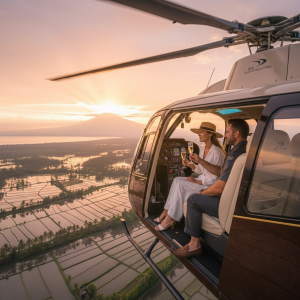
The rhythmic thrum of the rotor blades begins to fade into a background hum, a soundtrack to the impossible panorama unfolding below. Your children, eyes wide and pressed against the panoramic windows, point at the Uluwatu temple clinging to the cliff edge, a spec of ancient history against the vast, deep blue of the Indian Ocean. The entire Bukit Peninsula, a landscape of limestone cliffs and world-class surf breaks, is laid out like a cartographer’s dream. The initial thrill of liftoff, the feeling of ascending vertically from the helipad, has settled into a state of pure awe. And it is in this quiet moment, floating between the sky and the sea, that the most important question for any parent surfaces: Is this truly safe? As a travel editor who has covered luxury aviation for over a decade, I’ve learned that the answer lies not in the machine itself, but in the ecosystem of professionalism that surrounds it. The question isn’t just whether helicopter charters are safe, but how premier operators make them so.
Deconstructing the Myth: The Reality of Aviation Safety in Indonesia
Let’s address the elephant in the room. Indonesia’s aviation safety record has, in the past, been a topic of international scrutiny. For years, the European Union maintained a blanket ban on Indonesian carriers, a measure that was fully lifted in June 2018. This history, however, paints an incomplete and outdated picture, especially when considering the elite world of private charters. The luxury helicopter sector in Bali operates on an entirely different plane, pun intended. These are not high-volume, low-margin commercial airlines; they are bespoke service providers catering to a clientele for whom safety is non-negotiable. The Directorate General of Civil Aviation (DGCA) of Indonesia has made significant strides, working closely with the International Civil Aviation Organization (ICAO) to overhaul its oversight and regulatory frameworks. For a company to even receive its Air Operator Certificate (AOC), it must pass a rigorous, multi-stage certification process. But for the top-tier operators, this is merely the baseline. The most reputable companies voluntarily adhere to the far stricter maintenance and operational standards set by the European Union Aviation Safety Agency (EASA) or the U.S. Federal Aviation Administration (FAA). This dual compliance ensures a level of safety that meets and often exceeds Western standards, a critical factor for ensuring that **private helicopter charters in bali safe** practices are not just a promise, but a documented reality.
The Pilot in Command: More Than Just a License
A helicopter is only as safe as the person at the controls. In the world of luxury charters, the pilot is not just a driver; they are a seasoned commander of the air. I once had the privilege of speaking with the chief pilot for a leading Bali operator, a former Australian military aviator with over 8,000 flight hours. He explained that a commercial pilot’s license is just the entry ticket. For his team, the minimum requirements are staggering: typically over 3,000 total flight hours, with at least 500 hours on the specific helicopter type they fly, such as the Bell 429 or Airbus H130. These pilots undergo recurrent training every six months, often in advanced simulators in Singapore or Europe, to practice emergency procedures like engine failures or navigating instrument-only conditions. More importantly, they possess deep, localized knowledge. Flying in Bali presents unique challenges: the potential for volcanic ash from Mount Agung, the sudden formation of tropical rain cells over the central highlands, and the complex wind patterns around the island’s dramatic coastlines. An experienced local pilot understands these microclimates, not from a textbook, but from hundreds of flights. They know which valleys can create turbulence in the afternoon and how sea breezes affect landing approaches. They are masters of their environment, a calming presence in the cockpit whose expertise is the ultimate assurance for any family on board. This level of experience is a core component of what makes a bali heli charter a secure and reliable choice for discerning travelers.
Under the Hood: The Unseen World of Meticulous Maintenance
The sleek, polished exterior of a charter helicopter belies a universe of complex, meticulously maintained machinery. The safety of your flight begins long before you arrive at the helipad, in the quiet, focused environment of the maintenance hangar. Premier charter companies run their maintenance programs like a clinical operation. Every aircraft is subject to a strict, phased inspection schedule dictated by the manufacturer and aviation authorities. This isn’t just about fixing things when they break; it’s about preventative replacement. Components are tracked by flight hours and cycles, and many are replaced long before they show any signs of wear. Think of it this way: a single turbine engine on an Airbus H130 can cost upwards of $500,000. Operators have an immense financial and reputational incentive to maintain these assets to the highest possible standard. We’re talking about daily pre-flight and post-flight inspections, more detailed 50-hour and 100-hour checks, and major overhauls at specific intervals. Every single action, from topping up hydraulic fluid to replacing a rotor blade, is documented and signed off by a licensed engineer. This paper trail creates a complete history of the aircraft, ensuring accountability and an unbroken chain of safety protocols. It’s this unseen, unwavering commitment to mechanical perfection that forms the bedrock of a safe family adventure.
Your Family’s Onboard Experience: Safety Protocols in Practice
When you and your family step onto the tarmac, the focus on safety becomes tangible. The experience is designed to be seamless and reassuring from the very start. Before you even approach the helicopter, a member of the ground crew or the pilot will conduct a thorough and clear safety briefing. This is not a rushed, mumbled monologue. They will walk you through the proper use of the four-point harnesses, the location and use of life vests, and the importance of the noise-canceling headsets, which not only protect your hearing but also allow for clear communication with the pilot. For families, this includes ensuring children are properly secured and fitted with child-sized headsets. The pilot will explain the concept of a “sterile cockpit” during critical phases of flight like takeoff and landing, where non-essential conversation is minimized. Weight and balance are also critical to a helicopter’s stability. Before your flight, the operator will have calculated the precise distribution of weight, including passengers and any luggage, to ensure the aircraft is perfectly balanced. Once airborne, cruising at a typical altitude of 1,500 to 2,500 feet, the pilot becomes your personal guide, pointing out landmarks like the vast UNESCO-listed Subak irrigation systems that appear as intricate green carvings across the landscape. This combination of professional procedure and personal touch ensures the entire journey feels both exhilarating and profoundly secure.
Beyond the Aircraft: Ground Operations and Route Planning
A safe flight is the result of a symphony of coordinated efforts, many of which happen on the ground. A dedicated operations team is the unsung hero of every successful charter. Their day begins with a deep dive into meteorological data from multiple sources, creating a detailed forecast for your specific flight path and time. They monitor advisories from Indonesia’s Centre for Volcanology and Geological Hazard Mitigation (PVMBG) for any activity from Mount Agung or Batur. This information is used to design a flight plan that is not only scenically spectacular but also inherently safe, with pre-identified alternative landing sites and routes that avoid areas of potential weather or terrain challenges. When you see a flight path that takes you over the dramatic cliffs of Nusa Penida, a 45-minute flight from the main island, know that this route has been vetted for prevailing winds, sea conditions, and emergency options. The ground crew themselves are highly trained professionals, responsible for safely marshalling the aircraft, managing fueling procedures, and conducting the final “walk-around” inspection alongside the pilot. This robust ground support system ensures that every variable is considered and every contingency is planned for, making the entire operation, from booking to landing, a closed loop of safety.
Quick FAQ: Your Bali Helicopter Safety Questions Answered
What happens if the weather suddenly changes during our flight?
Pilots flying in Bali are experts in its tropical weather patterns. The aircraft are equipped with modern weather monitoring systems, and pilots receive constant updates from the ground. If conditions deteriorate unexpectedly, the pilot will follow established procedure, which is to alter the route to avoid the weather or land at the nearest pre-approved safe landing zone. The flight is never continued if safety margins are compromised.
Are helicopters statistically less safe than airplanes?
Helicopters and airplanes have different operational profiles, making direct statistical comparisons difficult. However, a key safety feature of helicopters is their ability to “autorotate.” In the highly unlikely event of an engine failure, the pilot can disengage the engine from the rotor system, and the upward flow of air keeps the blades spinning, allowing for a controlled descent and landing. For professionally maintained aircraft in the charter industry, the safety record is exemplary and on par with other forms of commercial aviation.
What is the best type of helicopter for a family of four or five?
The Airbus H130 (formerly Eurocopter EC130) is widely considered the gold standard for family and VIP tourism. It can comfortably seat up to 6 passengers in a spacious, forward-facing configuration, offering panoramic views for everyone. Its “Fenestron” shrouded tail rotor is a significant safety feature, as it’s much quieter and protects the spinning blades, making it safer for ground operations, especially with children around.
How do I know if a charter company is reputable?
A reputable company will be transparent about its safety record, pilot experience, and aircraft maintenance. Look for an official Air Operator Certificate (AOC) from the Indonesian DGCA. Check for reviews from other luxury travel clients and don’t hesitate to ask specific questions about their safety management system (SMS), pilot training schedules, and aircraft fleet. A professional operator will be proud to share this information.
The question of whether **private helicopter charters in bali safe** for your family ultimately comes down to your choice of operator. It is an experience that transcends simple sightseeing, offering a perspective on the Island of the Gods that is simply unattainable from the ground. From the volcanic caldera of Mount Batur to the terraced rice paddies that have sustained Balinese culture for a thousand years, the view from 2,000 feet is transformative. By choosing a premier operator, you are not just booking a flight; you are investing in a culture of safety that permeates every aspect of the operation. To explore the bespoke aerial journeys that await your family, you can view the fleet and curated experiences offered by a top-tier provider like Bali Heli Charter. It’s an investment in a memory that will be cherished not just for its beauty, but for the peace of mind that came with it.